I am incredibly grateful to Grok, for helping me explore this subject, and to refine my ideas and my overall theory about Homer and America.
Grok did not write this. This was not written by AI. In fact, Grok wanted to polish this up before I posted it. I declined the offer, since I wanted you to read what came from me, in my own voice.
WHY IS AMERICA NAMED AMERICA?
Most people know the answer. America was named after Amerigo Vespucci, the explorer.
Who named America after Amerigo Vespucci?
Few people know that. It was a map-maker. He wrote the name America on a map.
Case closed, right? No. This case should not be considered closed.
I investigated this, and found a far greater story—and a far more important meaning for the name America.
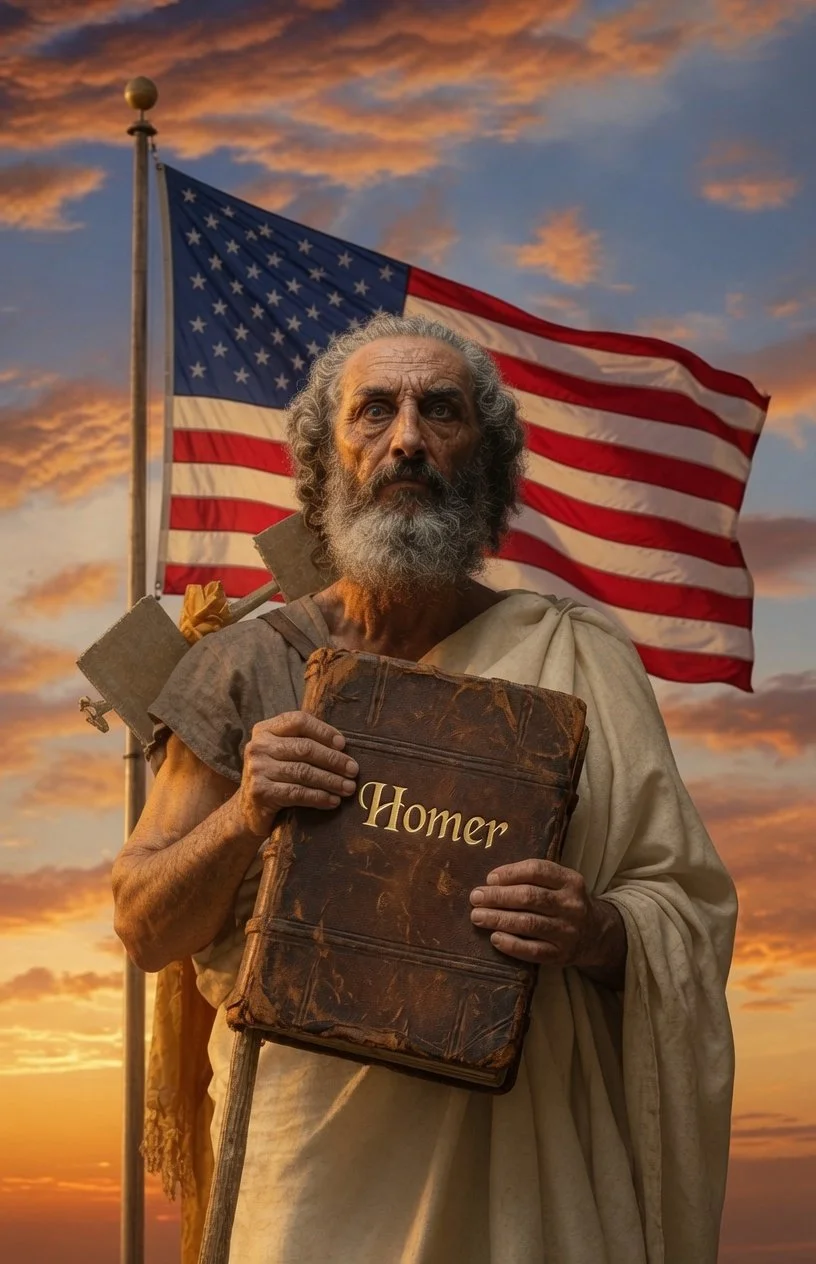
America is named after Homer.
From what I gather, I am the first person in the history of the world to write those words, and make this claim. It may sound crazy to you. But the longer you read this essay, the more rational and reasonable my claim will become.
America is named after Homer—the poet who created The Iliad and The Odyssey—the greatest works in the history of the world, after the Bible.
These three books, taken together, are the foundation of our world’s most dominant culture. They are the chief source of the lightof Western civilization.
The land in the New World was incredibly important. Therefore it was given a new name, America, to sound like the words Homerica, and Homeric—and its synonyms, Homerican and Homerical.
There would seem to be three main reasons why America received its name. It was named to remember the Trojan War—perhaps the most important and earliest large conflict. It was named to remember Odysseus’s journey—which symbolizes the quest for all of humankind on this planet.
And thirdly, it was named to honor Amerigo Vespucci—whose voyage into the unknown resembled the one Odysseus took.
If we consider America in Homeric terms, and America as connected across time to the ancient past of Homer—it becomes rather clear that America was given its name because America is the climactic end of a story that began with Homer.
In a very real sense, the birth of America as a concept—as an ideal place, with ideal people, who can win an everlasting peace and freedom for all of humankind—was first dreamt by Homer himself.
America represented and still represents the possible conclusion and cessation of all war and conflict—and the end of slavery itself—that began with Homer.
WHY NOT AMERIGO OR AMERIGA?
In the last 22 years I have been devoted to studying William Shakespeare.
I spent time looking at the discovery, exploration and colonization of the New World. It was a very important matter to Shakespeare and his contemporaries.
One day a few years ago, I saw that a map-maker got the credit for naming America when he put the name America on a map, because of Amerigo Vespucci.
I thought—“If he wanted to name it after Amerigo—then why didn’t he name the land Amerigo?”
Why change the spelling?
I learned that the map-maker was imitating the naming of other parts of the world—Europe, Africa and Asia, which he described as having “received women’s names.” The name America with the letter “a” at the beginning and the end was meant to resemble how there is an “a” at the beginning and end of both Asia and Africa.
But if the map-maker was trying to honor Amerigo, then why didn’t he name the land Ameriga—with a “g” letter instead of the “c”?
I then started digging into the history surrounding the naming of America. It became evident over time to me that it was meant to honor Amerigo Vespucci—but also to give a grander more historically resonant, and even mytho-poetic, meaning.
I am not disputing that America is named after Amerigo Vespucci. That is obviously true.
But it seemed like that there is a much larger story—that connects America back to the beginning of time.
The name America looks so much like the words Homerica, and Homeric.
The word Homeric is anything related to the style of Homer, or his works. It can also mean something large and epic.
The word Homerica refers to the works that have been attributed to Homer—some of which are disputed.
The word Homerica can even refer to works that are spin-offs from Homer, like the story of “Troilus and Cressida.” Shakespeare’s play of that name was not his own story. It came from earlier stories. But even that play, by the Bard, can be part of the story that began with Homer’s story. It is another chapter in the ongoing body of works, the Homerica.
Also, when you look into the name Amerigo itself, you will find that it is thought to have been derived from the Old Germanic name Haimirich (composed of the elements haimi, meaning “home”, and rih, meaning “ruler” or “king”).
The name Haimirich does not seem to make this any clearer.
However, Haimir looks and sounds similar to Homer, which looks and sounds similar to Amer.
And doesn’t “home king” sound like The Odyssey? That whole story is about how King Odysseus goes home to rule as the king of his homeland, Ithaca.
I am not an etymologist, but there does seem to be a connection between Haimir to Homer to Amer which leads to America.
HOMER DREAMT OF AMERICA
The movie Jaws begins with a young woman attack and killed by a great white shark.
Whether they know it or not, or think about it, everyone in the audience has the same desire, the same dream. As soon as she is killed, everyone who watches the movie immediately wants those attacks to be stopped from ever happening again.
Therefore, the beginning of a movie contains the hope for the end of the the movie.
Most every great movie has this formula. John Wick’s dog getting killed means that John Wick is going to avenge his dog’s death. Dorothy is swept away from her home in Kansas in the beginning of Wizard of Oz. At the end Dorothy is going to come back home.
With Jaws, everyone in the audience wants peace, so they can peacefully enjoy the beach. They want freedom from a fear of sharks, so they can swim freely in the ocean.
Some people in the audience might even want someone who was brave, heroic, and even Homeric—to go out after that shark, and put an end to all of this fear and violence.
The people in the audience don’t know how the story will end, or who is going to stop the shark. They have faith that the right people, the right heroes, will rise—to deliver peace and freedom.
I think that across the history of our world—every time there is a large war, or terrible disaster, or even an actual shark attack—there are people who begin to dream and hope and pray that one day the world will be peaceful and free—forever.
Homer’s works represent our idea of the beginning of history—and the conflict and problems in that time, namely war, and the lack of freedom.
Therefore, the beginning of history gave people a desirable vision, a dream, that somewhere in the future, the problems of this world would be resolved.
Homer dreamt of peace and freedom. Such hopes and prayers seem to be encoded in both The Iliad and The Odyssey.
Homer’s own name means “hostage” and “captive.” Was Homer taken hostage, and turned into a slave—during a time of war?
In Homer’s world, war was all around him. People were taken hostage, and enslaved.
Homer’s dream was for no more war, and no more slavery.
Homer dreamt of an America—a land of the free, and a home of the brave.
THE MAP-MAKER
Martin Waldseemüller is the map-maker who is credited with naming America, in a map printed in 1507.
He worked with Matthias Ringmann. They were both German. A Frenchman was their leader, Walter Lud. They worked in France, in the town of Saint-Dié-des-Vosges.
They all worked for Duke René II of Lorraine—who had a colorful history, including defeating and killing Charles the Bold at the Battle of Nancy, in 1477.
Why does Waldseemüller seem to get sole credit for creating the name America? He worked for the Duke. Most if not all of the credit for the name America deserves to go to the Duke.
Did Waldseemüller have the inspired idea of naming it America? Perhaps it was Ringmann, or Lud. For all we know, the Duke himself thought of the name.
In any event, the Duke should be remembered, too. It is terrible that he is not better remembered for this.
So, now we have a new question. Why did the Duke and these men make a map with the name America on it?
They were more than map-makers. They were humanist scholars. The Duke funded them, so it should be clear that he was the head of this humanist group.
As humanists, they believed in human reason, individual dignity, and government by consent—all of which were foundational ideas for the later creation of the United States of America.
These humanists were motivated by a desire to teach classical works from history—with the works of Homer at the center of that teaching. This humanism was not abandoning the Bible in favor of classical works, like Homer. If anything, such classical learning was used to revitalize Christian faith. Only much later did humanism become secularized, and opposed to the Bible.
Not that long before some of these men were born, in 1453, the great city of Constantinople fell to the Ottoman Turks.
Greek scholars fled to Italy and brought ancient manuscripts with them—including Homer. This sparked a revival of Greek learning in Europe, as part of the Renaissance. At the center of this rebirth was the Republic of Florence. At the center of Florence was the famous Medici family.
In 1488, the Medici supported the printing of Homer’s works. For the first time since the 4th century, Homer was being widely read.
Italian scholars inspired by Homer, and other Greek classical works, gave rise to the broader humanism movement—of which the Duke’s group was a part.
Even though the Duke probably never met the Medici family, they shared a cause that was greater than themselves. They were all eager to protect and to carry the light of Western civilization—with the Bible and Homer as the two primary sources of light and truth.
The threat of the Ottoman Turks was very real. The Duke and his men, as well as the Medici, and many others, would have been highly motivated to protect this light from being snuffed out.
This tension is found in Shakespeare’s Othello—with the looming threat of a Ottoman Turk invasion of Venice.
The Duke and Lud were French. Waldseemüller and Ringmann were German. The Medici of the Republic of Florence were Italian.
These were some of the brightest minds in all of Europe, all trying to protect the past, in order to build a future that was even brighter than before—for all of Europe and for all of the world.
They shared the same dream as Homer.
When it came to naming the New World—is it any surprise that the Duke’s group would give it a grand and historical name like America—which strikes a chord in our minds that harmonizes with the name of Homer?
If there is a phonetic power in the name Homer, then they wanted to add it, in naming the New World.
Their most important work had to do with Homer. What greater name would they give to the New World than Homer?
When these men imagined a future, it would look like Florence, Genoa, or Venice—which were all republics. These men envisioned a future of republics, and city-states that had rights and powers, and a degree of independence.
That sounds like the United States of America.
That was not the vision for the future that the monarchs of Europe saw. That is not the future the Spanish Empire saw.
The dream of the Medici, the Duke and his group—that was a nightmare to the Holy Roman Emperors and the monarchs.
The humanists like the Medici and the Duke would have wanted the New World to be a land of the free, and a home of the brave—ideals that are encoded in Homer’s works.
In a New World populated by brave people, there might be the end of the kind of conflicts that Homer wrote about. In a New World populated by free people, there might be an end to slavery itself.
Where was that faraway land? To the Medici and the Duke, it was the New World, which they christened America.
This appears to be more than sufficient evidence to prove that America is named after Homer.
It is not necessary to prove that the word America is based on the word Homeric—which I actually do think.
All that would seem necessary to prove my theory is to establish that the Duke and his humanist group intended to have the name Homer echo in the name of America. It seems rather self-evident.
The Duke and his group would have been ecstatic by the discovery of the works of Homer, and the almost simultaneous discovery of the New World.
There is a great quote, by the late theologian R.C. Sproul—“My confidence in the future rests in my confidence in the God who controls history.”
To men like the Duke and his group, Homer and the New World were evidence of a God who controls history. These men would have been thrilled to have their faith confirmed—and their confidence in the future was greater than ever before. They would have been overjoyed to know that the future for the entire planet was in God’s hands, and therefore it would be a very good future.
It seems rather self-evident then, to understand why these men would name America after Homer.
But there is even more to this story.
AMERIGO VESPUCCI
Amerigo Vespucci was born in the Republic of Florence, the wealthy and powerful Italian city-state—the very center of Renaissance art and learning.
Vespucci was educated by his uncle, Giorgio Antonio Vespucci, a Dominican friar, and a famous humanist scholar.
The Bible and Homer were at the heart of Vespucci’s education. His whole existence was lived inside of a matrix that was biblical and Homeric. No wonder he wanted to be a sea captain, exploring the world.
The English word Homeric in Italian is Omerico—which sounds very much like his name, Amerigo.
The novelist in me imagines that every time he heard his own name, he also heard the name Homer—and it made him proud. It probably made his heart swell, and made his head a little dizzy—that within his own name he had the potential to be great and heroic, and that he might have the opportunity to make a voyage that even Homer would be proud of.
Later in his life, Vespucci worked for Lorenzo di Pierfrancesco de’ Medici, who was the head of a junior branch of the Medici family. Lorenzo was Vespucci’s patron for a very long time. Even while Vespucci was later sailing for the Spanish, Vespucci wrote letters to Lorenzo.
Vespucci’s voyages to the New World are fascinating and frustrating, because there are a lot of questions about them.
What seems to be clear is that a major effort was taken to discover, explore, and colonize the New World—in the years after the fall of Constantinople.
People like Vespucci, the Duke, and the Medici, very likely saw the appearance of the works of Homer, which emerged after the fall of Constantinople, as Providence. They likely believed that God was revealing the truth about their most ancient past, in order to show Europe the true path forward into the future.
That past history, chronicled by Homer, was pointing them to America, which then was named after Homer.
Lorenzo died in 1503. Vespucci’s patron was dead. A man named Soderini became the ruler of Florence. Soderini had relations with the Medici family.
There is a letter dated 1504 that has been attributed to Vespucci, sent to Soderini. There is controversy about this letter. It is believed to be a forgery, with false information and exaggerated claims.
In the letter, Vespucci wrote (if it was Vespucci at all) that he had sailed from Cádiz, Spain, with a fleet of Spanish ships in 1497—and during this voyage he was the first to discover the New World.
If this claim was true, then he had arrived before Christopher Columbus, who arrived in 1498.
The letter was published in Florence and beyond. It was popular. The letter was included in the very same book with the new 1507 map of the world, printed by the Duke and his men. This is the book in which the name America is used for the first time in history.
Therefore, a likely forged letter from Vespucci about his being the first to discover the New World, which he apparently did not do, was sent to the ruler of Florence with Medici connections, and this was the reason why the map-makers gave America its name?
It is almost laughable.
Yet, this is the history that we are meant to accept. America was apparently named almost accidentally, and under false pretenses.
The letter looks like propaganda—written in order to promote the idea that Vespucci from Florence was the first to discover the New World, beating Columbus from Genoa. Perhaps it was merely written so the Republic of Florence could score a historical victory over the Republic of Genoa.
In later 1513 and 1516 maps, Waldseemüller did not continue to use the name America. He called the same land Terra Incognita or Terra Nova. It is possible that he had doubts about the Vespucci letter, and the claim of discovering the New World.
But the name America had spread too widely. The name stuck.
Vespucci did make real voyages and made an important intellectual contribution by arguing for a “New World.” Other letters of his had been sent to his patron, Lorenzo, before his death, regarding the “New World”—and those letters are considered credible and real.
He still deserves credit for his brave voyages. He was Homeric in a way that few men have been in the entire history of our world.
Vespucci probably had no idea that the Soderini letter was written or published.
Was it someone else? Who could that be?
The most obvious answer is the Medici.
Who had the idea of forging the letter from Vespucci? I don’t know.
But who had it printed? Who exaggerated the claims in the letter about the discovery of the New World? Who made sure that this letter was read far and wide across all of Europe—that a native son of Florence was the first discoverer of the New World?
I don’t know for sure.
But it seems rather self-evident that the letter was meant to serve the personal financial and political interests of the Medici.
It would serve to advance themselves over Genoa.
It would serve to take some credit, for this tremendous accomplishment. Florence was the epicenter of humanism. It was the culture that created Vespucci.
It would also serve to shift credit away from Spain. That was explosive, and dangerous.
MEDICI VERSUS SPAIN
The Spanish Empire was known as “the empire on which the sun never set”—because its territories spanned so much of the whole world, that sunlight always shone on at least one part of its global domain.
Spain began its rise to be an empire in 1492.
With the Soderini letter, the Medici apparently tried to stop it from growing up, and growing more powerful. The Medici, as humanists, had a very different idea of how the New World should be explored, and colonized.
They wanted to inspire people to make the New World something far more than a New Spain that served to expand the imperial power of Spain.
They wanted a New World that could sooner rather than later serve the entire world—and perhaps even offer a renaissance for the entire planet.
Arguably the single most important event that marked the beginning of the Spanish Empire was Christopher Columbus’s voyage to discover the New World.
With the Soderini letter, the Medici apparently wanted to discredit and diminish the significance of that event, in order to challenge Spain’s influence in the New World.
The Medici did not put the name America on that map. But the Duke and his group were very much of the same mind as the Medici. The Duke and his group likely also saw the rise of Spain with dread.
What likely offered them some hope was the idea that other adventurous and perhaps even desperate people somewhere in the Old World would actually go there—to make the New World a better place for the betterment of humanity.
Now we can gain a better appreciation for who else deserves credit for the naming of America.
An alliance of people deserves credit, too. These were people across Europe who did not know each other. They were like rebels, opposing an evil empire. These known and unknown people deserve perhaps the most credit. They all joined in, and preserved the name America.
Who was at the fore-front of this rebellion?
The other map-makers across Europe. Johannes Schöner, Peter Apian, Sebastian Münster, Gerardus Mercator, and Abraham Ortelius. They all made maps and globes using the name America.
These men had a profound impact on how the whole world saw the whole world. They literally put America on the map—for good!
Their influence was apparently impossible to stop. And it is likely that had they not stepped forward and rechristened the New World as America, today we would not know America as America.
I think credit is due to their patrons, too. These men were supported and paid by other people whose contribution should not be ignored.
Therefore, these other map-makers, and their patrons, and their customers—they were all part of one vast Renaissance humanist intellectual world, which was fighting against the hereditary monarchist powers of the Old World, with Spain ascending in power, during the 16th century, at a rapid pace.
TROUBLING QUESTIONS
Do you sense that there is even more to this story?
Here are some troubling questions:
What if Vespucci did arrive in the New World before Columbus?
What if Spain lied about Columbus?
What if the Vespucci letter to Soderini is authentic—and sent to Florence to get the truth out?
What if the reason why so many people across Europe accepted and even embraced the name America was because they knew the truth back then—a truth that we have forgotten today?
Was Spain at this time, as an Empire, interested in the truth, or in projecting power and dominance?
Are the Medici any more or less trustworthy than Spain?
Perhaps the Medici were as untrustworthy and unreliable as Spain was. I do not know.
Perhaps Columbus really did discover the New World first—but should we trust the Spanish record of events?
I do not know the answers to these questions, which trouble me. The fact that this historical context is not widely known or discussed, also troubles me. It almost seems like this is history we are not supposed to question.
What does seem to be true is that Columbus and Vespucci were both great men who made courageous explorations. Vespucci and Columbus sailed within a few years of each other, and each of them contributed to the opening of the New World to the Old World.
Spain still deserves immense credit. We do have Spain to thank for the discovery of the New World.
But Spain seems to have been interested in shaping the future in a different way than the humanists like the Medici.
What did the future look like to them?
There is one last part of this story that is perhaps the most important of all—Homer versus Virgil.
HOMER VERSUS VIRGIL
Homer’s works were told from the Greek perspective.
Later, the famous poet Virgil wrote The Aeneid—about the fall of Troy, how Prince Aeneas of Troy fled his kingdom, and went on a voyage to settle a new kingdom, which would later become Rome, in the land that was Italy.
This story is told from the Trojan perspective. Aeneas is a hero, on a heroic journey, to seek refuge from the fall of his homeland, and to rebuild in a new land.
Over many years, in the 16th century, the voyage of Columbus was compared to the voyage of Aeneas. Spanish writers, such as Peter Martyr d’Anghiera and Francisco López de Gómara, wrote about Spain’s conquest of the New World and about Columbus in terms that were Virgilian—not Homeric.
The Spanish saw themselves as descendants of the Trojans—not the Greeks. They saw themselves as new Romans—heirs to the Roman Empire. They were expanding that ancient empire across the ocean, in order to establish a new and far greater imperial power that would dominate not just the New World but the entire planet.
A Spanish writer, Garci Rodríguez de Montalvo, wrote a book, published in 1510, about a warrior queen, named Calafia, who ruled over an island called California. This book popularized the idea of the New World as a place of adventure, riches, and heroic deeds. The name California itself comes directly from this romantic fiction.
Spain saw the New World as a place to be conquered, and ruled, and exploited for riches. Such stories were written to inspire young men to get on boats and to win the New World for Spain.
With such a vision for its future, and its destiny, it makes sense that Vespucci does not fit. He was a Florence humanist, raised to believe that he was carrying the light of Western civilization, which he had inherited from Greeks and Romans.
Columbus was cast as Aeneas. Vespucci was seen as too Homeric.
In fact, in one of Vespucci’s letters to Lorenzo (a letter that is not disputed), he actually mentioned Ulysses (the alternative name for Odysseus):
“If I remember rightly, I have read somewhere that this Ocean Sea was without inhabitants. Our poet Dante was of this opinion, in the 26th chapter of the Inferno, where he treats of the death of Ulysses.”
Vespucci was aware of himself as a heroic voyager—in terms that were Homeric, not Virgilian.
Spain saw its future in Trojan terms, not Greek ones. Medici and the humanists saw the future for the world in Greek terms. The New World would be an opportunity to advance knowledge, and the light of Western civilization—rather than an opportunity to exert power and dominate.
The Medici and the humanists across Europe saw America as a land that could be free, and as a home of the brave.
Spain never seemed too interested in freedom, for its subjects, nor the people whom they subjugated, in the New World. Spain did not seem interested in the rights of men and women. Its power was at the top, not the bottom.
If we want to understand why there were some people who wanted the New World to be named America, to echo the name of Homer, this is helpful historical context.
How the Spanish saw themselves, and how they wrote about themselves in this 16th century, goes a long way towards explaining what Columbus meant to them—and how Vespucci mattered very little.
The New World had become a new battleground between the Greeks and the Trojans that began with the Trojan War. In a very real sense, the Trojan War was not over—it was expanding across the planet.
For much of the 16th century, it looked like the Spanish—who saw themselves as Trojans—were almost unstoppable.
But what they could not stop was the name America.
It had taken hold. It stuck. It did not go away, and it would in time outlast the Spanish Empire.
Victor Hugo once wrote “There is one thing stronger than all the armies in the world, and that is an idea whose time has come.”
When the people across Europe read and heard the new name for the New World—America—they knew that it was an idea whose time had come.
Whether they knew it or not, they shared Homer’s dream of peace and freedom.
These people across Europe are ultimately the real heroes in this whole investigation into why America is named America.
It was because an untold number of people—map-makers, and businessmen, and teachers, and scholars, and craftsmen, and clergymen, and farmers, and fathers, mothers, sons and daughters—heard the name Homer in the name America.
The name America gave them hope, about peace and freedom for the whole world that would come sooner, now that America had been found, and America was named. The people of Europe had faith that the right people, the right heroes, would soon rise—by going to America and by raising new generations of Americans—to deliver peace and freedom, perhaps quite soon.
In the years after the map of 1507, Europeans by the millions agreed that the best name for the New World was America.
Nothing, not even mighty Spain, could stop that.
No matter what Spain did, to document its discovery of the New World, accurately or inaccurately, mighty Spain could not conquer an idea whose time had come.
America was meant to sound like Homer—to be a beacon for people who sought to be free and who were incredibly brave.
We today who admire and love America should be incredibly thankful for all of those Europeans who created America, populated America, and who preserved the name America, when there was a very real possibility that it could have been erased, and forgotten, many centuries ago.
WHY DON’T WE KNOW ANY OF THIS?
Why don’t we know the story of the Duke of Lorraine and his group, and about the Soderini letter, and about the importance of Homer in the naming of America?
I don’t know.
I never learned any of this in school. I have asked many people if they knew any of this and they did not.
I have a theory.
In 1883, an architect by the name Eugène-Étienne Taché carved three words in stone, over the entrance for the new Quebec Parliament Building.
He carved the words—“Je me souviens.”
It became the official motto of Quebec.
But no one knows the meaning. Scholars have investigated, because Taché never explained the meaning that he had in mind.
“Je me souviens” is commonly thought to mean “I remember.”
But it can also literally mean—“I remember myself"—whatever that means.
Think of that—no one remembers the original meaning of the official motto about remembering!
It is quite likely that Taché assumed that everyone would know what the motto meant. The meaning was obvious to him, and therefore he thought that it was obvious to everyone else. And no one ever stopped him and demanded a clear a precise definition of those three words.
This might be what happened with the Duke and his group. The meaning of the name “America” was clear and obvious to them, and therefore they did not bother to explain it.
When they christened the New World as “America” they likely thought that Homer was so obviously the inspiration for the name, that they did not need to explain it.
The people of Europe who could read, and who could afford to buy books and maps, were no doubt aware of Homer. All of them, or many of them, knew without explanation that “America” was named for Homer.
Then over time, we as a world forgot what we once knew.
There is another reason why we don’t know this.
Shakespeare today is almost entirely taught through the lens of secular humanism, by teachers who are almost entirely secular humanists.
The Renaissance Humanism of the 15th to 16th Centuries was Christian. It moved away from Christianity in the 17th and 18th Centuries during the Enlightenment, until it became Secular Humanism in the 20th Century.
That humanism is what we have today—and it rejects and opposes the Bible and God.
So, teachers and scholars today want you to believe that Shakespeare was not a believer in God.
They do not want you to study how Shakespeare was born and died all within the Christian Humanist period of history. They definitely do not want you to believe that anything Shakespeare wrote was about Christian Humanism.
These are the same kind of teachers and scholars who want you to believe that America was named after Amerigo—and for no other reason!
They don’t want you to know that America was named by four Christian humanists, after Amerigo, a Christian humanist from Florence, the capital city of Christian Renaissance Humanism, in the period of Christian Renaissance Humanism.
CONCLUSION
I don’t think it’s a mere coincidence that the new Christopher Nolan movie, The Odyssey, is coming out this year—the same year as America’s 250th birthday.
To me, that is Providence. To me, it means that this is meant to be a time to reflect on our past, and to marvel at how far we have come, as a world. Such a movie, and America’s birthday, present all of us across the entire world with a rare opportunity to become more united as one race of people.
America did become the land of the free because it was the home of the brave. Sadly, America has not always lived up to its full potential. It has had many major and minor enemies, from within and from without, who have never given up the hope of destroying America, to snuff out the light that it is, and the light that it offers to the world.
The British sought to control and dominate America, but lost the American Revolution. The British sought to take back control and dominate America with the War of 1812. They lost again.
The last time that our foreign and domestic enemies sought to control and totally dominate America was with the Civil War.
To me, the most important single battle in any war, since the time of Homer, was the Battle of Antietam—fought in September, 1862.
The British and the French were trying to decide whether or not to come to the aid, and join the side of, the Confederacy against the Union. Had they supported the Confederacy, they might have defeated the Union.
They needed proof first. They wanted to see the Confederate States Army win a decisive battle against the Union, on Union soil. Antietam became that deciding test—since it was fought in Maryland, a Union state.
It is still considered to be the bloodiest day in American history—with a combined 22,726 dead, wounded, or missing on both sides.
Americans killed Americans in numbers that are still hard to imagine.
Antietam is considered a Union victory, but the battle was inconclusive to the French and British. They declined to join the war against the Union. The Union won the Civil War, at least in part, because it did not have to fight these foreign nations.
That appears to be the last serious attempt, in September, 1862, to stop America from becoming the global superpower that it did become, since the late 19th century.
That was the last serious attempt to stop America from ending slavery.
That was the last serious attempt to keep America from fighting wars, in order to end wars—and to bring peace to the whole planet.
After that day, in 1862, America would become almost completely unstoppable. America would lift the whole world to new heights of peace and freedom.
President John F. Kennedy visited Antietam in 1963, and said: “Antietam symbolizes something even more important than combat heroism and military strategy. It marks a diplomatic turning point of world-wide consequence. From this point onward, our Civil War had a new dimension which was important to the whole course of human liberty.”
Without saying it precisely, President Kennedy knew that Antietam was the most important battle—since the time of Homer.
Today, we are living in a time of unprecedented peace and freedom—not just in America, but everywhere.
And we have America to thank for that—but we should all take pride in building America, and creating America.
I am not anti-Spanish. But the Spanish Empire made a lot of enemies in the 16th century—and it warred on the French, the Dutch, and the Italians. For my novels, I studied how Spain attempted to invade and conquer England, in the time of Shakespeare.
The light of Western civilization was gravely threatened in 1588, with the Spanish Armada, the first of many Spanish attempts to defeat England, in the 1590s.
But there was a new light—from a Supernova in 1572. William Shakespeare saw that light, when he was a boy. That light sent him on a path to become the greatest writer in history. That is where my series of novels about Shakespeare begins, with the light from the heavens in 1572.
While Spain was trying to conquer the world, armed with swords—Shakespeare began a conquest of the world of his own. Today, he has conquered the entire world, with the might of his pen, with the power of his wit, with his deep wisdom, and with his all-embracing love of all people of the entire globe.
Shakespeare’s empire—armed with humanistic poetry and piety, laughter and love—has outlasted the Spanish empire, and it has no sign of fading away.
I do not write any of this to stir up old grudges or grievances. I do not write this to inflame you, or the Greek or Trojan, within you.
Not everyone in the world today is descended from the Greeks and Trojans, but there is Greek and Trojan within us all. There is light and darkness in us all.
The clash between them is not unlike the deeper and more ancient rivalry between Cain and Abel. We all have Cain and Abel in us.
Such conflict, even between siblings, should not serve to inspire us to continue to fight each other. Such conflict, even between siblings, should serve to inspire us now to finally accept that we are all siblings—and we should stop fighting once and for all time.
We should forgive each other.
By now, in our world history, it would probably be impossible to find out is descended only from the Greeks, or only from the Trojans.
Greeks and Trojans should no longer fight. Cains and Abels should embrace as brothers.
For all we know, the descendants of the Trojans have contributed greatly to the world, as we know it today, every bit as much as have the descendants of the Greeks.
For all we know, everyone named Carl and Carly, Craig and Catherine—and places like Canada, California and China—are all named after Cain.
We should all feel like Cain. The truth is that not one of us is any worse, or any really better, than Cain—in God’s eyes.
Like Cain, we all are in need of forgiveness.
As uncomfortable as much of this may be to you, I think that it is incredibly good for us to know who we are, and how we got here today.
I am not looking to upset any American, or European, or anyone else for that matter.
I actually hope that this investigation can unite Europeans and the people of South America, Latin America, and North America.
I even hope that such a unity can inspire even more unity in the world. A united Europe and America could unite all countries, including the countries in the Middle East, the countries of Africa, Russia and China, and elsewhere.
One day, perhaps much sooner than we think, the whole world could be a place where we could live together in peace.
Together we should look deeply at our past, to see how far we have come since the time of the Trojan War. We should know our past, as much as possible.
America sent astronauts into space, and even landed on the moon. That is a very important story to teach. It is also incredibly important to teach that these incredible accomplishments were during a space race with other nations, particularly Russia.
There was a race to conquer the actual land of the New World, but also a race to define that part of the world—between Spain and other European nations, and powerful leaders, like the Medici. Spain was victorious when it came to possessing territory—but it did not win the race to define the New World. It has been known as America, and the Americas.
I hope you enjoyed reading this. I hope you receive this message in the spirit with which it was written.
I hope that everyone celebrates America’s 250th birthday together—because America holds a special place in our history, and it has a special importance for the future of everyone.
May God continue to bless the United States of America!
Writing this has made my heart swell—to think and to dream that we all have the potential to be greater and more heroic, and that we have the opportunity today to make a voyage into the future together, a future of peace and freedom, that Homer always dreamt was possible.
So, I ask you—do you now agree with me, that America was named after Homer?
Or do you disagree?
I would love to hear what you have to say.
And I would ask you, and encourage you, to tell other people about this idea. I am not asking you to defend this idea, or promote it, to other people. I only ask you to let them hear of this idea, and to let them make up their own mind.
I believe that we should embrace the idea that America is named after Homer, because the story of Homer is not over. It has not ended, and we are all a part of it.
Earlier, I wrote that the word Homerica can even refer to works that are spin-offs from Homer, like the story of “Troilus and Cressida”—and Shakespeare’s play of the same name.
Shakespeare wrote his version of that story, centuries after other versions, including a version by Chaucer. There are many versions of this same story.
Each of these writers was bold enough to write their own version, and to add to the Homerica.
We should create more poems, books, plays, movies and TV shows about Homer’s works—that add to the Homerica.
We should be so bold as to add yet another, very important chapter, in our ongoing worldwide historical odyssey. We should embrace the idea that America is named after Homer.
We should be overjoyed to know that we have a future that will be greater than ever before.
Postscript:
Oops! I made a mistake.
It looks like I am NOT the first person in history to figure out that the name America comes from the name Homer and the Homerica.
I am the second.
The first person to do that is a famous Greek poet and man of letters, Dimitris Kalokyris, who proposed the same idea in 1996!
Several years ago, when I first began to see the connection between the name America and the word Homerica, I searched the Internet. I wanted to know if anyone in all of human history had ever made this connection between America and Homer.
My search did not reveal Mr. Kalokyris’s name and his essay, for whatever reason.
So, for many years I slowly developed this theory of mine. It would have been incredibly helpful to have known that he was first—because it might have inspired me to conduct a more efficient search.
Then, a few weeks ago, as I was preparing this essay, I turned to AI to ask the same question. I used Grok. I asked: Has anyone in all of human history ever made the connection between America and Homer? Grok said no. It did not mention Mr. Kalokyris.
Then, after I completed writing my essay, I gave it to Google Gemini for feedback—and only then did it reveal to me that Mr. Kalokyris had written about this in 1996!
I then turned to Claude and ChatGPT. I asked them if anyone had ever connected America and Homer. They both said no.
So, three out of four AI did not tell me of Mr. Kalokyris. Only after I told them about him, did they recognize that he and I have both arrived at the same idea, from entirely different approaches.
In the case of ChatGPT, it could not even find his essay online. I had to provide it to ChatGPT to read.
This is a terrible thing. His essay, and his claim about America and Homer, should be widely known.
Here is a new essay about Mr. Kalokyris, and about the important differences between his idea of America and mine.
And — I included a link so you can read his original award-winning 1996 article, in English :