“This is the definitive historical fiction about Shakespeare!”
“A towering achievement!”
“Dive deeper into the miracle of Shakespeare with these extraordinary and entertaining historical novels—and celebrate America’s secret forefather. The books are mind-changingly great and a lot of fun!!”
“I was shaken and awakened by these books.”
“As far as the audiobooks are concerned, the kind of excellence experienced with the Shakespeare and the Dragon audiobooks series happens when the author is also an actor. Just like Shakespeare.”
“One can’t know how I’ve waited for someone to get this right ever since the movie Shakespeare in Love reductively portrayed William Shakespeare.
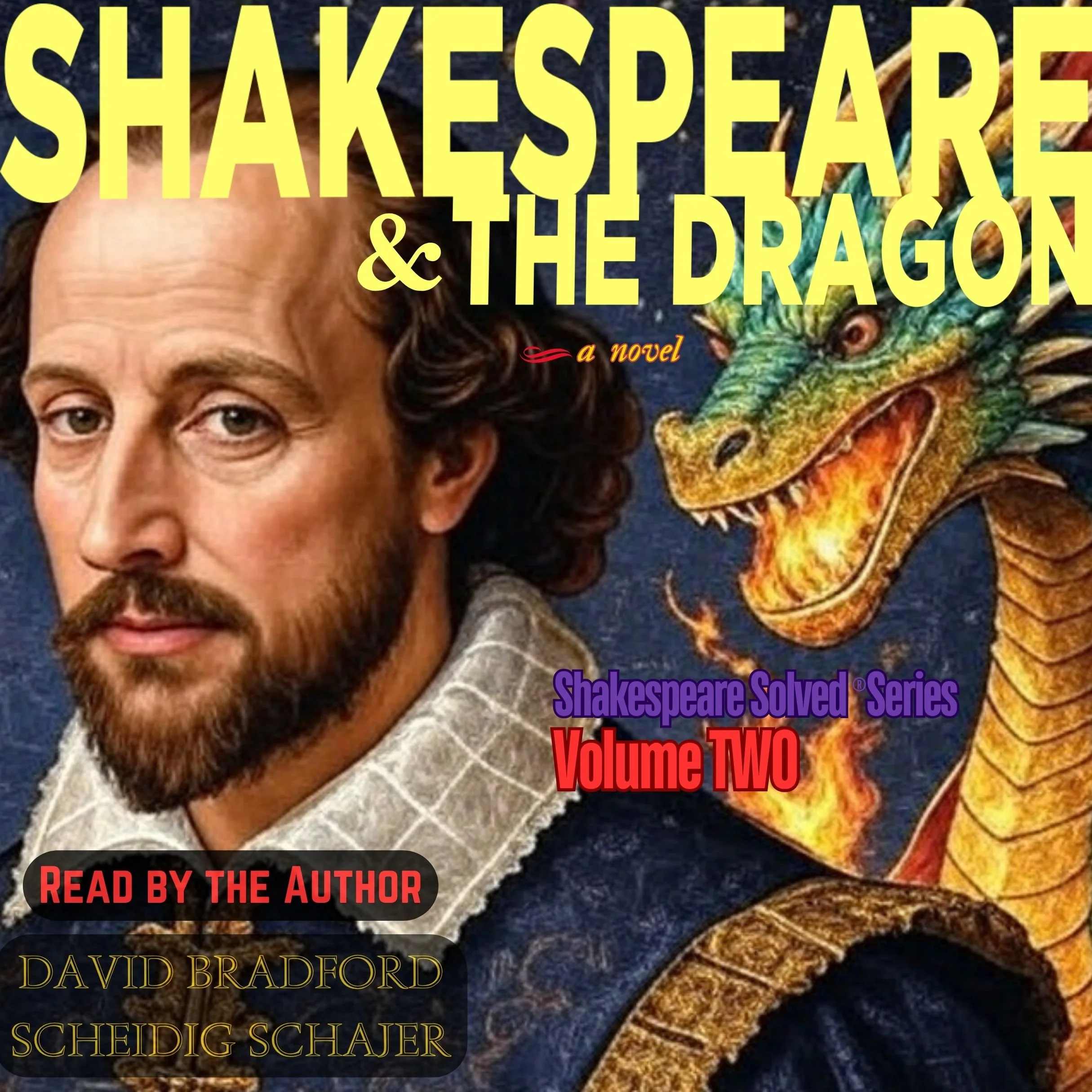
In Volume 2 of Shakespeare & The Dragon: Shakespeare Solved® Series, David Schajer explains how a young William Shakespeare reads the books in which he immerses himself: “With every book he read, he found himself stepping into the minds of the figures in the book.” Then Schajer, as he often does, doubles down on the significance of this insight: “Their thoughts became his thoughts.” Schajer’s reiterations form part of the pleasure of the books’ syntactical rhythms, driving ever deeper with bracing clarity.
Although Volume 1 of this historical-fiction series ends before Shakespeare puts quill to paper to draft one of his titanic plays, Schajer unites the mind of the reader to the mind of Shakespeare as he develops the knowledge, experience, and impetus for his art. Shakespeare lives in a world of monumental change: the age of exploration, empire, and discovery of the New World; the crest of the Enlightenment’s recrudescence of Classical philosophy and art; and the Protestant Reformation, which reshapes the world. Shakespeare finds himself at the center of a tempest as the person best equipped to unify these revolutions in human consciousness into a popular body of work.
Schajer opens the book with the perfect metaphor for Shakespeare’s mission: a dream-memory of a miraculous star—a divine lodestar—before a maelstrom pulls him under. Chapter 2 transitions from Shakespeare’s contemplation of his recurring nightmare's significance to the dream of a young Earl of Essex, then Chapter 4 shifts to a doomed Mary, Queen of Scots, who no longer dreams. By alternating perspective between Shakespeare and other figures of the age connected to Queen Elizabeth I’s efforts to maintain power, Schajer plumbs the characters’ subconscious through articulation of their conscious thought. Although stylistically and cumulatively different, Henry James similarly focuses on individual thought processes, analyses of events, and determinations to create further actions, while the incidents themselves occur "offstage." In this way, Schajer reveals not only the development of Shakespeare’s imagination—the vernacular life from which he drew, a concept reduced to "in-jokes" by Shakespeare in Love. He also shows Shakespeare's insight into the audience he needs to reach.
Schajer achieves this at the blessed expense of setting description except when needed to serve thematic richness. He demonstrates the principle during Mary’s execution, a grotesque guignol with Elizabeth’s counselors and local witnesses serving as spectators. To such folk, Shakespeare will serve his dramas with animal bladders filled with gore. By understanding the gruesome imaginations of his audience and the pressures of the age upon them—the needs he addressed—Schajer’s Shakespeare leaves little doubt that one man authored Titus Andronicus, Macbeth, Hamlet, King Lear, the Henriad, A Midsummer Night’s Dream, and The Tempest. This man.
Schajer reintroduces Shakespeare’s project and, in the face of academic assault, ideologically driven restagings, libelous biographies, and revisionist historical fiction (like the anti-religious, anti-art lies of Hamnet), affirms the singular man and purpose. With Olympian perspective into the minds of myriad characters who shaped history, Schajer’s articulation reveals his own personality and purpose. He returns Shakespeare as a deposit for future generations—this generation—born of the Bard's era and in need of his guidance through turbulent times.
—film critic John Demetry