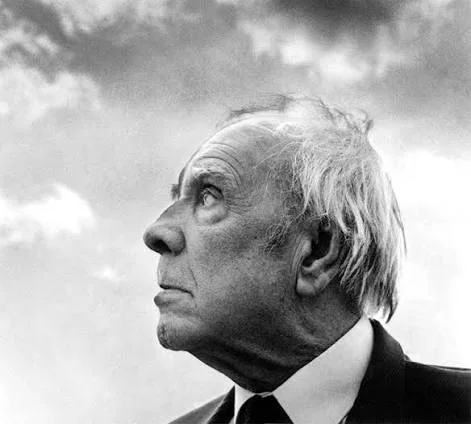
I recently read a mind-blowing short story by Jorge Luis Borges—“Shakespeare’s Memory”—from 1983.
In the story, a Shakespeare scholar named Hermann Sörgel magically receives the actual memory of the actual William Shakespeare. But unable to balance his own life while also remembering so much of Shakespeare’s own life, he transfers the memory to someone else.
I have not read Borges in many years—not since my university days, around the time I was studying Nietzsche and Kafka.
I did not read him since then, because I have spent over 20 years with Shakespeare on my mind—and to the exclusion to most everything else.
After reading this story, I had a strange thought: “Has anyone ever suggested that Borges wrote that story as a confession about himself?”
It is intriguing that the names Sörgel and Borges are both spelled with -orges- in the middle of each name.
Did Borges perhaps experience having the memory of Shakespeare bestowed upon him?
It may not have been as dramatic as the story says. Perhaps it was a severe bout of Einfühlung—which means an aesthetic empathy, or “in-feeling.”
As I write my historical fiction about Shakespeare, I find myself remembering things as I write, as if they are Shakespeare’s own memories.
For almost twenty years I wrote screenplays—and I know what it feels like to write creatively, as if I am the one and only author of my writing.
When I write about Shakespeare, I do not feel a sense of creating. It is more akin to remembering very specific memories. It sometimes feels like I am taking dictation. I often refer to it as entanglement.
In Borges’s story, he uses certain words, and expresses certain thoughts that suggest that he was indeed writing about actual events in his own life.
In the story, Borges refers to a ring that allowed Solomon to understand the language of the birds.
When I read that, I almost fell out of my chair!
To me, that is evidence that he himself held Shakespeare’s memories in his own consciousness in some uncanny way.
Over the years, my study of Shakespeare has afforded me insights into language that I can not claim to be my own.
For many years now, I compared Shakespeare’s sensitivity to language and playfulness with words as his own understanding the language of the birds!
He was very likely teased as a boy, and called a “gull” since his name was the Latin word for William--Gulielmus.
Shakespeare helped me to hear the name of Homer in the word America.
I even see the name Othello derived from the name Odysseus.
Othello is portrayed as a similar wanderer and storyteller. Othello's mention of cannibals echoes the Laestrygones.
When I look at a name like Borges, I wonder if he was descended from the Italian Borgia family. I also see Voorhees and Borges as the same name.
If no one else has ever claimed that Borges wrote that story as a confession about himself, then let me be the first to do so.
It is also interesting that the story was the very last one that Borges ever wrote.
That suggests to me that it was a story that was more important than most—and perhaps even the most important of all.
I do believe that I am not the first person who received special or privileged insight into Shakespeare’s works and his biography.
I believe there were others—especially David Garrick, the famous 18th century Shakespearean actor. Garrick described himself as the “high priest of Shakespeare.” It was Garrick who radically changed our understanding and admiration—and even devotion—of Shakespeare.
I believe that in the last 400 years, a small group of people have been able to connect to the mind of Shakespeare, in some uncanny and inexplicable way.
Garrick was one—perhaps for many years. Borges was one—but perhaps for a short time.
In Kenneth Branagh’s early years—especially during the time he created the film version of “Henry V”—I believe that he was inspired by the spirit of Shakespeare. But over time, I believe that Branagh lost that connection.
It is a shame that he Borges not continue with that effort. It is a shame that he did not pursue that as far as he could. We might have learned the truth about Shakespeare far earlier.
Sincerely,
David
P.S.
There was a real Herman Sörgel, a German man, who proposed a project in 1928 known as Atlantropa (originally called Panropa)—a colossal geoengineering and colonization project.
Designed as a utopian solution to Europe's post-World War I economic turmoil, unemployment, and looming energy shortages, the core plan was to partially drain the Mediterranean Sea to merge Europe and Africa into an unassailable Afro-European supercontinent.
I would not be surprised in the least that Borges knew of this German man, and his utopian project.
I am not sure why Borges chose this precise name—but perhaps in his mind, Borges thought that receiving the mind and memory of the actual Shakespeare was an impossibility akin to merging Europe with Africa.